Your true ikigai
meaning + purpose + fulfillment · 生きがいAn interactive tool that blends ancient Eastern philosophy with the modern Western diagram to help you deepen your self-knowledge and bring more light to your purpose journey.
Where should we send
your ikigai resources?
Leave us your name and email to receive: Access to the mini-course "Encounters With Your Purpose" with audios and practical tools, resources, and access to our community
Your information is confidential. No spam.
What values guide
your most important decisions?
Choose the 5 values you consider most important in your life. There are no right answers, only authentic ones.
What do you love doing?
In which activities do you lose track of time? What would you do over and over, even if no one paid you for it?
If time, money, and responsibilities
were not an obstacle...
What would you do? Describe your ideal day with total freedom. Let your imagination speak without filters.
What do you excel at
most naturally?
Choose up to 3 general areas and then go deeper into the specific skills within each one.
When someone comes to you for help,
what's it usually about?
Think about what your friends, family, or colleagues ask you for most often. That's a strength too.
What need in the world
moves something inside you?
If you had a magic wand to change something in your family, community, country, or the world, what would it be?
Your everyday ikigai
Japanese ikigai lives in the small things: in the rituals, the people, and the moments that make life worth living. Read each statement and mark how much it resonates with you today.
Which season do you feel you're in
on your purpose journey?
No season is better than another. Each one has its own wisdom and beauty.
The elements that give your life the most meaning
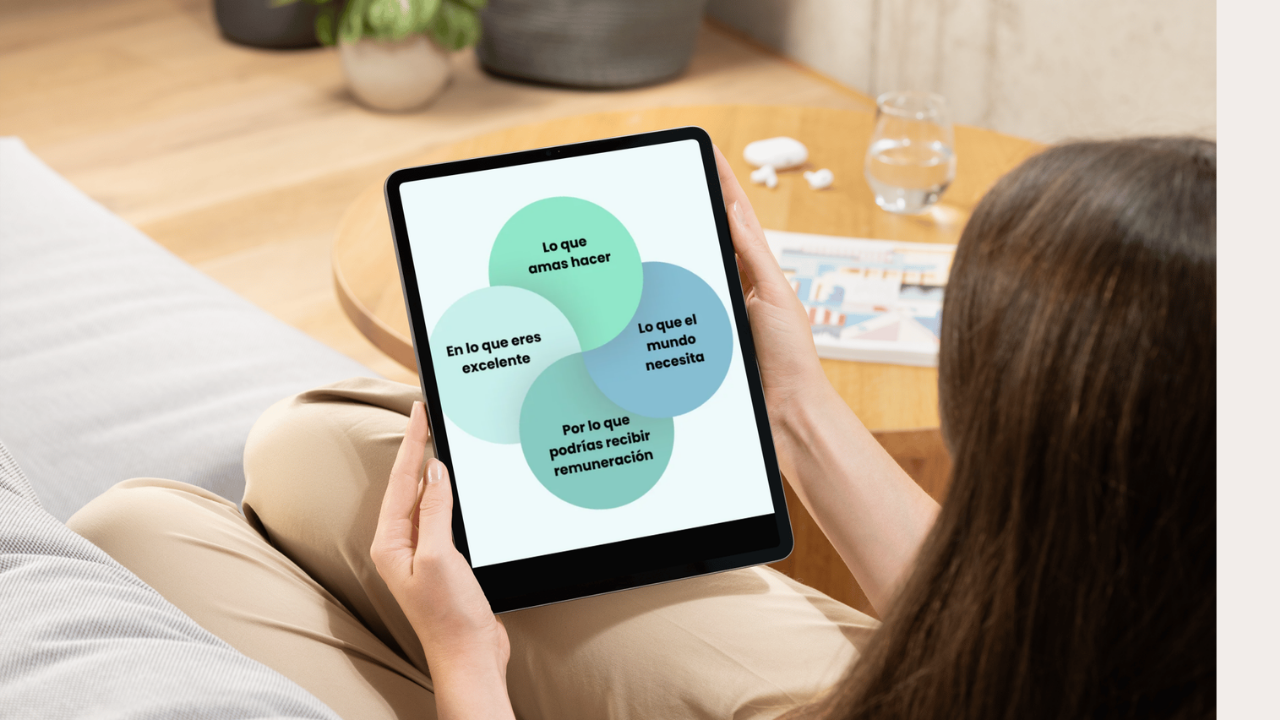
The 4 elements of your Ikigai
Concrete monetization ideas, in case they're helpful
The words that painted your dream day
These are the essences that emerged when you imagined your life without limits.
Your ikigai in everyday life
Some dimensions of meaning and what you're currently experiencing.
The moment you find yourself in today
Some of the lights that illuminate your life with greater meaning, purpose, and fulfillment
The roots of Ikigai
In the East, Ikigai is a profound concept for connecting with everything that gives your life meaning — the big things, the small things, and what you feel as you live them. In the West, we recognize Ikigai as a tool that helps you find the intersection of 4 elements to guide your path toward greater personal fulfillment.
This tool brings both perspectives together and offers you:
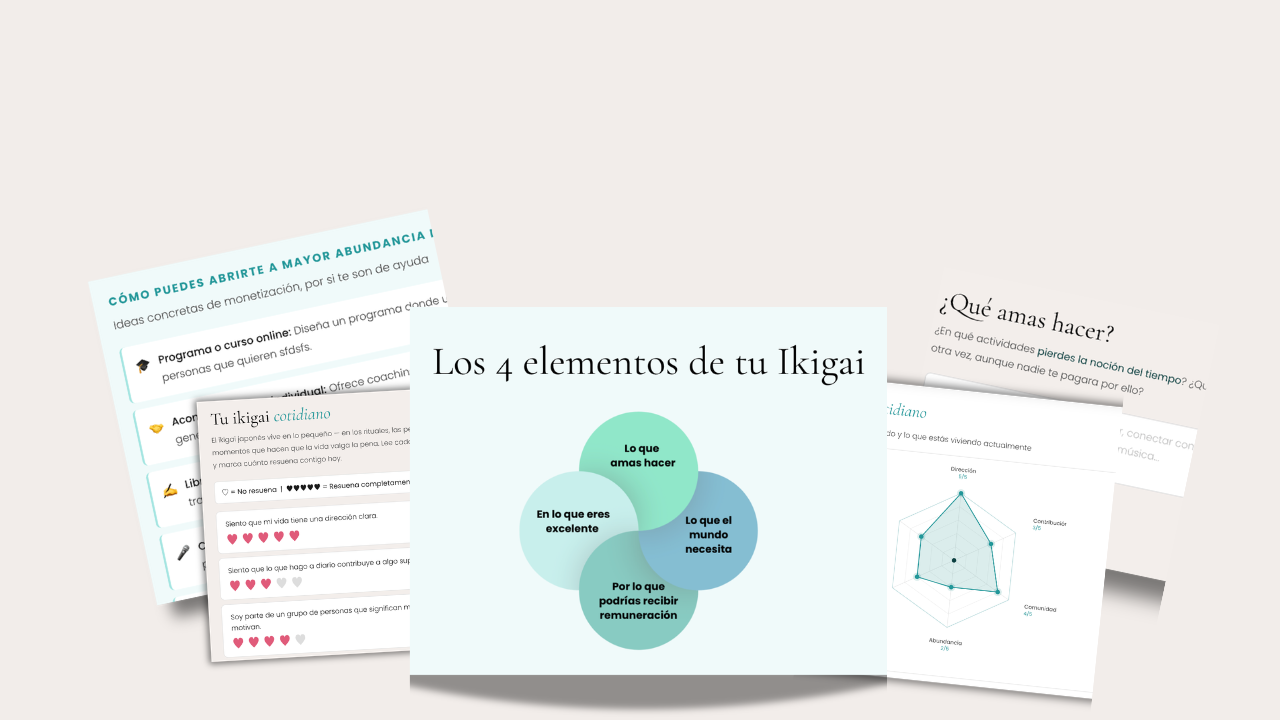
- 1A visual report of the 4 elements of the ikigai diagram.
- 2A map of what fills your life with meaning, and the areas where you feel a lack of purpose or fulfillment.
- 3A list of concrete activities to open yourself to greater abundance.
- 4The lights that fill your life with enthusiasm.
- 5Additional resources to go deeper into your personal purpose.
What does Ikigai mean
in Japanese culture?
Ikigai is a Japanese concept that combines the terms iki, meaning "alive" or "life," and gai, meaning "benefit" or "value." Together, they point to whatever gives your life meaning, purpose, or value — similar to the French term raison d'être, or "reason for being."
It's defined as a state of wellbeing that arises from engaging in activities you enjoy and that also create a sense of fulfillment. It differs from the Greek concept centered on fleeting pleasure (hedonia) and aligns more closely with eudaimonia — the idea of a life well lived that leads to the highest and most lasting form of wellbeing.
Ken Mogi, a neuroscientist and the author of Awakening Your Ikigai, translates the concept simply as "a reason to get up in the morning," or more poetically, as "waking up to joy."
Mogi describes ikigai as a spectrum — it can be something as small as savoring a cup of coffee with a good friend, spending an afternoon in the garden, watching a sunrise, or playing with a grandchild, all the way up to a single defining goal for an entire life. In his view, the complexity of ikigai simply mirrors the complexity of life itself.
— Inspired by Ken Mogi, neuroscientist and author of "Awakening Your Ikigai"Mieko Kamiya
It's important to honor the cultural heritage of this concept. The word Ikigai has existed in the Japanese language for centuries, but it was psychiatrist and writer Mieko Kamiya who brought it into academic and philosophical discourse with her seminal work Ikigai ni Tsuite (生きがいについて), published in 1966.
Kamiya described Ikigai not as a state of passive happiness, but as an active source of meaning and vitality — something that gives direction to life, and whose absence can lead to a profound existential emptiness. Her work was especially significant because she developed it while working with leprosy patients in Japan, people who faced devastating social stigma yet still found deep reasons to keep living. Kamiya observed that those with a clear Ikigai sustained their psychological wellbeing even under the most adverse conditions.
According to Kamiya, Ikigai has two fundamental aspects:
She emphasized that Ikigai is both internal (a sense of fulfillment) and external (a reason or motivation).
Ikigai refers to the sources that fill your life with meaning and motivation. These can include small joys, daily practices, hobbies, places, life-affirming moments, soul-nourishing work, roles, relationships, goals, ambitions, and challenges — both your biggest aspirations and the everyday. It isn't a single factor; it's the sum of all of them.
Is ikigai the same as purpose?
No. Purpose is a central aspect of ikigai, but ikigai is broader. When Japanese speakers connect purpose with ikigai, they generally use the term shimei-kan, which translates as "sense of purpose" — highlighting that, in the context of ikigai, purpose is something you feel, not something you achieve.
The origin of the
4-circle diagram
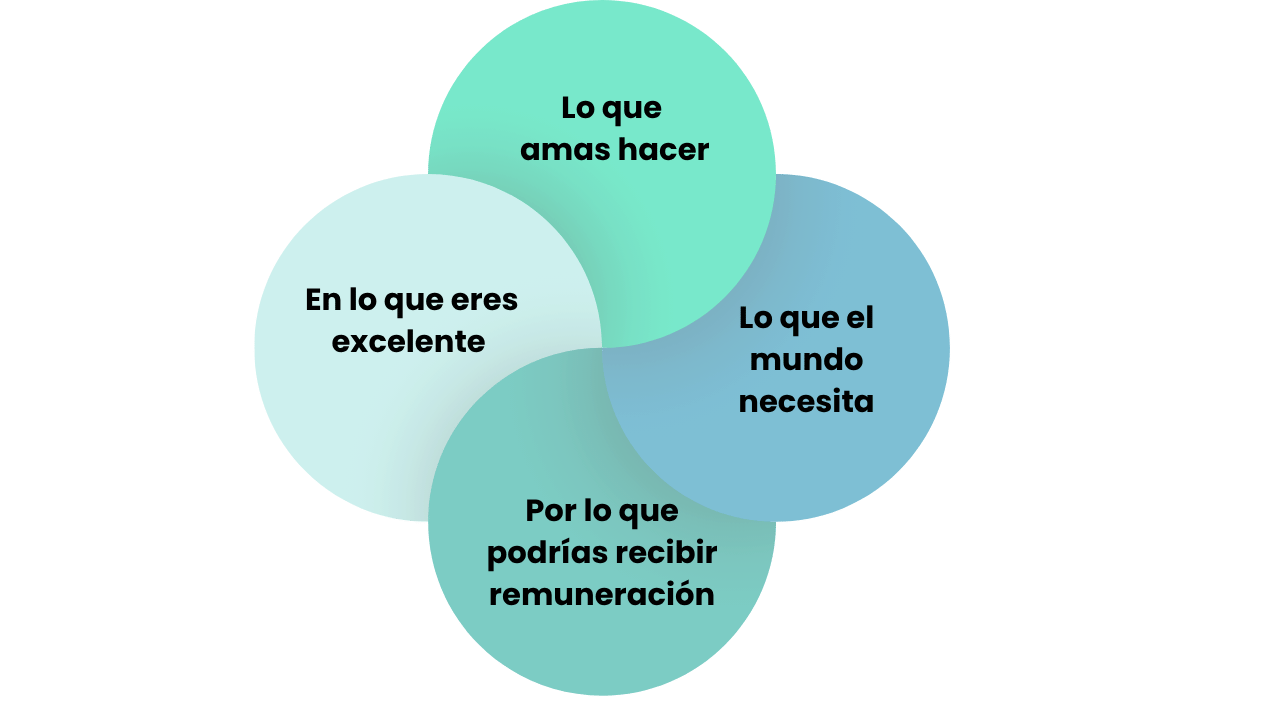
The Ikigai concept became popular in the West largely through the work of several Spanish authors. Originally, Andrés Zuzunaga designed it in 2011 as a purpose diagram, not an ikigai one. In 2014, American blogger Marc Winn, after watching a TED talk on Japanese longevity, took that diagram and simply swapped the word "purpose" for "ikigai." His post went viral and was seen by tens of millions of people — but a native Japanese speaker wouldn't recognize this diagram as reflecting the cultural meaning of ikigai.
The diagram is extremely valuable as a visual tool. However, it can perpetuate a few misconceptions:
- That ikigai is only achieved when all four conditions are met simultaneously.
- That there's only one correct answer.
- That ikigai is the same as purpose.
- That ikigai requires monetary exchange.
Does that mean you shouldn't use it? Not at all. It's concrete, it offers valuable answers, brings clarity, and can spark powerful epiphanies. Use it with awareness of what it is: a self-discovery tool, not a complete cultural definition.
The 4 elements of
your Ikigai
What you love
What you enjoy and what fills you with enthusiasm, delight, or joy — the activities where you can lose yourself for hours, savoring every minute.
Your strengths
Skills you've learned or cultivated, along with innate talents — the things you do exceptionally well, with ease.
What the world needs
This can refer to humanity as a whole or to a small community close to you. It connects explicitly with doing good beyond your own needs.
What you can be paid for
The activities through which you can open yourself to greater abundance, financial compensation, or other forms of reward.
The intersections between these elements reveal important concepts:
Passion
What you love + what you're good at
Mission
What you love + what the world needs
Vocation
What the world needs + what you can be paid for
Profession
What you're good at + what you can be paid for
Every path of self-discovery is valuable. It all begins by opening a space of stillness to deepen your connection with your inner wisdom, recognize the journey you've traveled so far, and identify what you want for your future. Thank you for using our tool — we hope you enjoyed it.
What did you learn about yourself as you visualized your ikigai?